

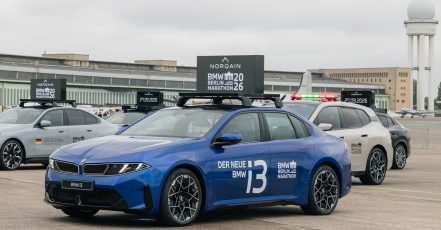
More and more companies are harnessing the appeal and reach of major sporting events to bring their brands to life. BMW did exactly that at the 2026 Berlin Marathon. As the official lead vehicle for the men’s elite race, the new all-electric BMW i3 was not simply given a prominent visual presence at the event; it was integrated directly into the sporting action itself. From a live communications perspective, this is particularly interesting: sponsorship became a functional and dramaturgically relevant part of the event experience.
On 27 September, Berlin once again became the stage for one of Germany’s most internationally visible running events. More than 84,000 participants from 162 nations took part in the 2026 BMW Berlin Marathon, with the programme also featuring handcycle and wheelchair races.
BMW supported the event as title partner for the 15th time, having been involved since 2011. The partnership extended well beyond brand and logo visibility. In total, BMW provided 60 course and organisational vehicles to support the staging of the marathon.
It is precisely this operational integration that makes the partnership particularly relevant from a live communications perspective: the vehicles simultaneously served as essential tools for the organisers, highly visible brand ambassadors and integral elements of the imagery generated and distributed throughout the race.
New BMW i3 Leads the Field
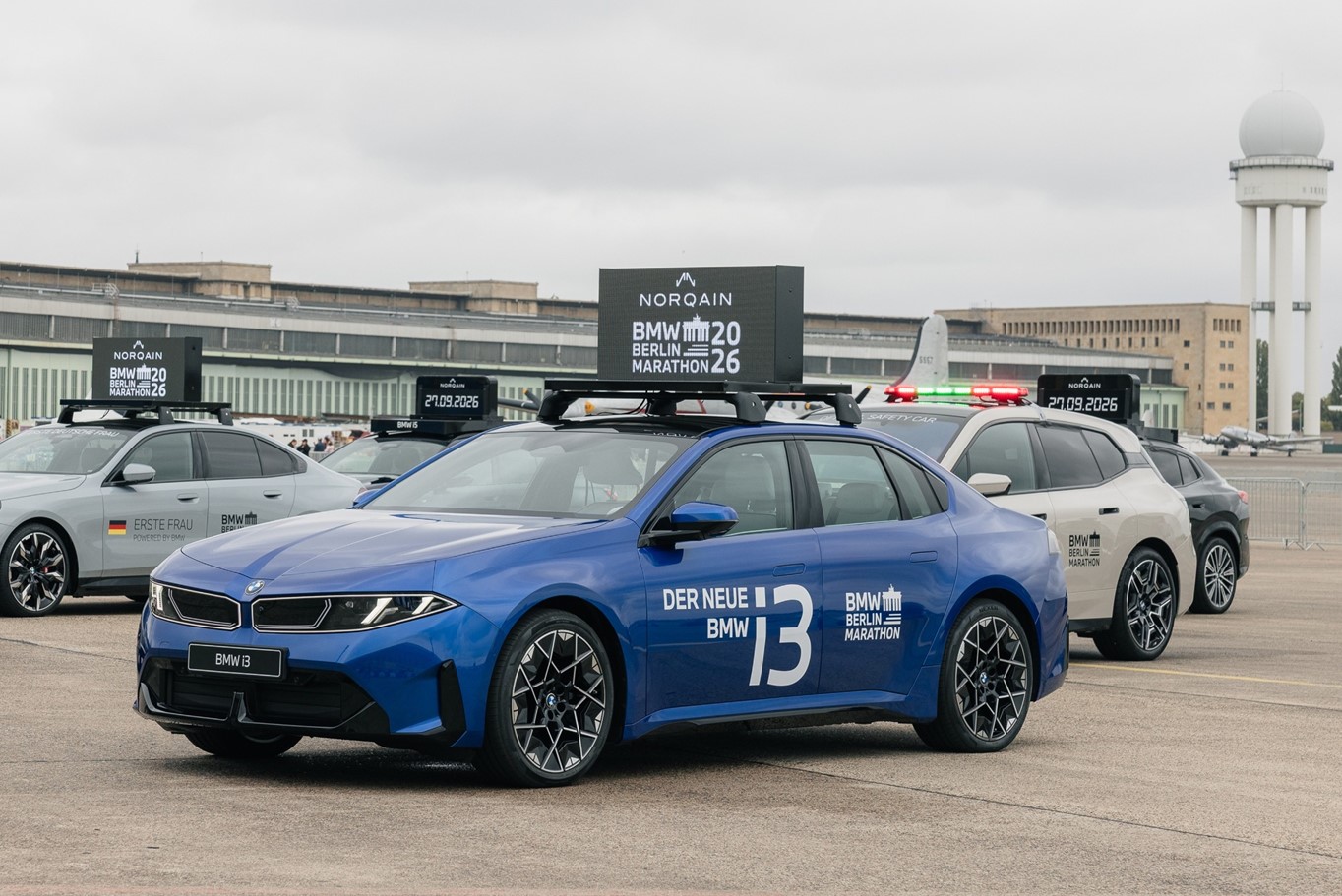
The new all-electric BMW i3 took on a particularly prominent role in 2026. Berlin marked one of the model’s first public appearances on the road. In the men’s elite race, the i3 served as the official lead vehicle, driving directly ahead of the frontrunners.
This gave the product launch an unusual stage. Rather than encountering the new model in a conventional vehicle presentation, participants and spectators experienced it in motion – and as part of an internationally prominent sporting event.
For BMW, the appearance came at a strategically relevant time. The new BMW i3 is the second model in the company’s Neue Klasse generation, with deliveries of the vehicle, manufactured at BMW Group’s main plant in Munich, due to begin later in 2026.
Tim Beltermann, Head of BMW Germany, said:
"We are very much looking forward to the first ‘race outing' for the new BMW i3. For seven generations and more than five decades, the BMW 3 Series has stood for sheer driving pleasure, innovation and timeless design. It is an icon – just like the BMW BERLIN-MARATHON. The new BMW i3 is also an endurance specialist in its own right. With an all-electric range of up to 906 kilometres, it could complete all seven World Marathon Majors for two and a half years without having to recharge."
Technological Transformation Meets Endurance Sport
With the first all-electric BMW 3 Series, the manufacturer brings together several technologies from its new vehicle generation. These include sixth-generation BMW eDrive technology, the new BMW Panoramic iDrive, the Heart of Joy high-performance computer and BMW Symbiotic Drive for assisted driving.
According to BMW, the Heart of Joy high-performance computer operates ten times faster than previous systems and, together with three additional high-performance computers, forms the core of the brand’s new software and electronics architecture.
For the event activation, however, the individual technical specifications were less important than the context in which these innovations were presented. The marathon gave BMW the opportunity to showcase electric mobility not as a promise of the future presented on a stage, but as a natural, functional part of a real-world major event.
60 Vehicles as Part of the Event Infrastructure
The i3 was only the most visible element of a much broader mobility concept. In total, BMW deployed 60 course and organisational vehicles at the 2026 Berlin Marathon.
A BMW iX served as the official safety car. The new BMW i3 led the men’s elite field, while a BMW iX3 served as the lead vehicle for the women’s elite race. The national elite fields were accompanied by a BMW i5 for the men and a BMW i4 for the women.
In addition, all-electric BMW iX, BMW i5, BMW i4, BMW iX2 and BMW iX1 models were used in the organisation and operation of the event. The fleet was complemented by 14 BMW motorcycles and two BMW e-scooters.
The motorcycles also brought a local connection to the partnership: BMW motorcycles have been manufactured at the BMW Group plant in Berlin since 1969.
From Logo Placement to Functional Sponsorship
BMW’s involvement in the 2026 Berlin Marathon illustrates a development that is becoming increasingly relevant to sponsorship and live communications. Brands are no longer relying exclusively on logos, advertising space or hospitality to achieve visibility. Instead, products and services are increasingly being integrated into events in ways that serve an actual function.
The BMW Berlin Marathon provided a clear example of this approach. A lead vehicle is required for the sporting operation of the race in any case. By assigning that role to a new product, BMW created a touchpoint that was both operationally necessary and valuable from a communications perspective.
EventMasterBook Editorial Comment: The Mechanics Behind the Activation
What makes BMW’s involvement interesting is not simply the fact that an automotive manufacturer sponsors a major marathon. More revealing is the way in which product, event and media narrative were connected. The underlying mechanism can be described as functional product integration.
BMW did not simply position the new i3 somewhere with high footfall. The vehicle was given a genuine role. As the lead vehicle, it drove immediately ahead of the fastest men in the race – automatically placing it in one of the event’s most visible and closely followed environments.
Integrating the product into one of the event’s key moments generated several communications effects:
First, it created physical visibility along the course. Spectators experienced the new vehicle in motion rather than as a static display.
Second, it generated media visibility. The lead vehicle became part of the imagery produced around the frontrunners by camera motorcycles, photographers, news media and social media channels.
Third, it created a semantic connection between product and event. A marathon represents endurance, efficiency, performance and the intelligent management of available energy. These are precisely the themes to which an electric vehicle can connect from a communications perspective. BMW made that association explicit by highlighting the vehicle’s potential range of up to 906 kilometres, as referenced in Beltermann’s statement above.
Fourth, the sponsorship became a form of "proof of benefit." BMW’s electric mobility was not communicated solely through technical specifications or advertising. It became visible and tangible within the context of a real major event.
This also reflects a contemporary approach to brand communication. Increasingly, products are no longer staged merely as objects to be observed. Instead, they take on an active role in moments that carry wider social and cultural relevance.
For the events industry, this points to an important principle: effective brand integration does not necessarily require additional activation spaces or ever more elaborate branded environments. It can become more powerful when a brand assumes a necessary or meaningful function within an event – and when that function simultaneously tells a story about the brand itself.
The communications value then lies not in drawing as much attention as possible to the product. It lies in connecting product attributes, utility and narrative in a way that creates a relevant and credible expression of the brand.
Cover Image: The new BMW i3 served as the official lead vehicle for the men’s elite race at the 2026 BMW Berlin Marathon. (Credit: BMW Group)
Related Topics:
BMW Berlin Marathon 2026, BMW BERLIN-MARATHON, BMW i3, new BMW i3, event marketing, live communications, sponsorship, sports sponsorship, brand experience, brand activation, product presentation, product integration, functional sponsorship, live product placement, electric mobility, automotive events, event concepts, events industry, sporting events, Berlin Marathon, BMW Neue Klasse, BMW eDrive, Heart of Joy, BMW Panoramic iDrive, BMW Symbiotic Drive, brand experience, experience marketing
Summary (Abstract):
BMW used the 2026 Berlin Marathon for one of the first on-road public appearances of the new all-electric BMW i3. Serving as the official lead vehicle for the men’s elite race, the car was functionally integrated into the sporting event itself. In total, BMW provided 60 course and organisational vehicles, as well as 14 motorcycles and two e-scooters. From a live communications perspective, the partnership demonstrates how sponsorship, product presentation and a product’s functional role within an event can converge. The central mechanism is simple: rather than merely being advertised, the product assumes a meaningful role within the event.
Originally published on EventMasterBook.de | Translated and edited for EventMasterBook.com. Please excuse any translation errors. Read the original article (German): Funktionales Sponsoring: BMW Berlin-Marathon 2026 – So wird der neue BMW i3 Teil der Inszenierung


