

Communicating with attendees is one of the core responsibilities in event management. Whether it’s a conference, trade show, or festival, questions about program schedules, rooms, catering, or last-minute changes are part of everyday operations. Traditional information channels often reach their limits: information desks require significant staffing, emails or notice boards frequently provide incomplete updates, and international events in particular face language barriers.
This is where Artificial Intelligence (AI) can make a real difference. The popular AI tool ChatGPT by OpenAI enables automated, 24/7 responses to attendee inquiries in natural language. By using a chatbot as a digital event assistant, information processes can be significantly streamlined, staff resources conserved, and overall attendee satisfaction increased.
In this expert article, the EventMasterBook editorial team explains how Artificial Intelligence can be applied at events and in event management. The focus is on automating attendee communication—and how this can be successfully implemented with ChatGPT, specifically through an event app within the ChatGPT ecosystem.
ChatGPT as a Digital Assistant for Attendee Communication
ChatGPT is an AI-based language model that understands natural language and generates context-aware responses. For improving attendee communication at events, a dedicated app within ChatGPT can serve as a highly effective digital information point. Attendees can ask questions such as "When does Ms. Smith’s presentation start?", "Where is Room 3?", or "Are vegetarian catering options available?"
The AI accesses previously stored event data, interprets each question, and delivers a clear, relevant response. The result is an event-specific attendee service that is available at any time via ChatGPT.
Typical Use Cases for AI-Powered Attendee Communication
An AI-powered event app can handle a wide range of tasks. At its core is the information service: attendees can retrieve program details, room allocations, directions, and venue maps. Support-related questions – such as check-in procedures, networking options, or general event workflows – can also be answered automatically. Thanks to its ability to process multiple languages simultaneously, ChatGPT is particularly well suited for international events.
Benefits for Organizers and Attendees
For event organizers, a ChatGPT app-based chatbot provides significant operational relief. Standard attendee questions no longer need to be handled manually, physical information desks can be reduced, and information quality remains consistent across all touchpoints. Because the service is delivered through a ChatGPT app, it is available 24/7, scales effortlessly with growing attendance, and can be updated centrally in real time.
For attendees, this means instant, personalized answers regardless of location or time. Conversational interaction makes information easier to find, improves service quality compared to static FAQ pages, and lowers the threshold compared to traditional helplines.
Data Protection and Responsibility
The use of AI requires particular care with regard to data protection and responsibility. The AI must not disclose any sensitive personal data unless it has been explicitly approved. All data processing should comply with GDPR regulations.
In addition, it must be communicated transparently that the app is an automated, AI-powered service that provides certain types of information while potentially excluding others. Regular quality checks help prevent misinformation and ensure reliable performance.
Cost Efficiency Through Automation
Event chatbots deployed as dedicated apps within ChatGPT operate on a usage-based pricing model via APIs. Costs are determined by the number of requests, the length of generated responses, and the underlying language model. For small to mid-sized events, total expenses typically remain in the low double-digit Euro range.
Compared to staffed information desks or traditional helplines, a ChatGPT app-based chatbot represents an attractive, scalable, and flexible solution for delivering cost-efficient attendee communication at trade fairs and larger business events.
How Do You Build an Event Chatbot That Works with ChatGPT?
Here is the short but practical answer:
Such functionality can be developed using OpenAI’s APIs and the ChatGPT app framework, combined with custom development (code, UI, backend). The app connects to ChatGPT via APIs, and usage costs are covered by the app publisher based on actual usage intensity (as described above).
The process of being included in the ChatGPT app ecosystem typically follows these steps:
Build the app → submit it to OpenAI → undergo OpenAI review → upon approval, publish it in the ChatGPT App Directory.
From both a technical and content perspective, such a project should be approached as follows:
A ChatGPT-based event app designed to answer a wide range of attendee questions (When does workshop X start? Where is Room B? Is vegetarian food available? Who is speaking at 3 p.m.? Where can I park? Can I download the presentations later? etc.) requires access to relevant, structured event information. This includes detailed program schedules (PDF or website), venue maps, FAQ content, catering menus, speaker profiles, emergency instructions, and more.
This information is either embedded directly as a knowledge base or retrieved dynamically from databases. ChatGPT then uses this information to generate clear, user-friendly responses.
Such an application is commonly referred to as a "chatbot with its own knowledge source" or, in technical terms, Retrieval Augmented Generation (RAG). Optional features may include multilingual support, event updates delivered through the app (e.g., "The room has changed"), or feedback and interaction functions.
Looking Ahead: From Information Chatbot to Personal Event Assistant
In the long term, AI-powered chatbots can evolve from simple information systems into active companions for attendees. They may create personalized daily agendas based on individual interests, recommend relevant sessions, support visitor flow management, and integrate with ticketing and CRM systems.
How the transition from a traditional information desk to a personal event "co-pilot" can be successfully achieved will be explored in an upcoming article on EventMasterBook.com. Tip: Follow us on Instagram @eventmaster.club or sign up at our community website EventMaster.club to stay up to date with the latest expert articles.
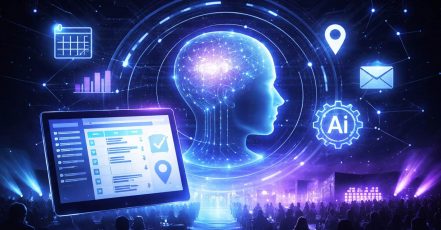
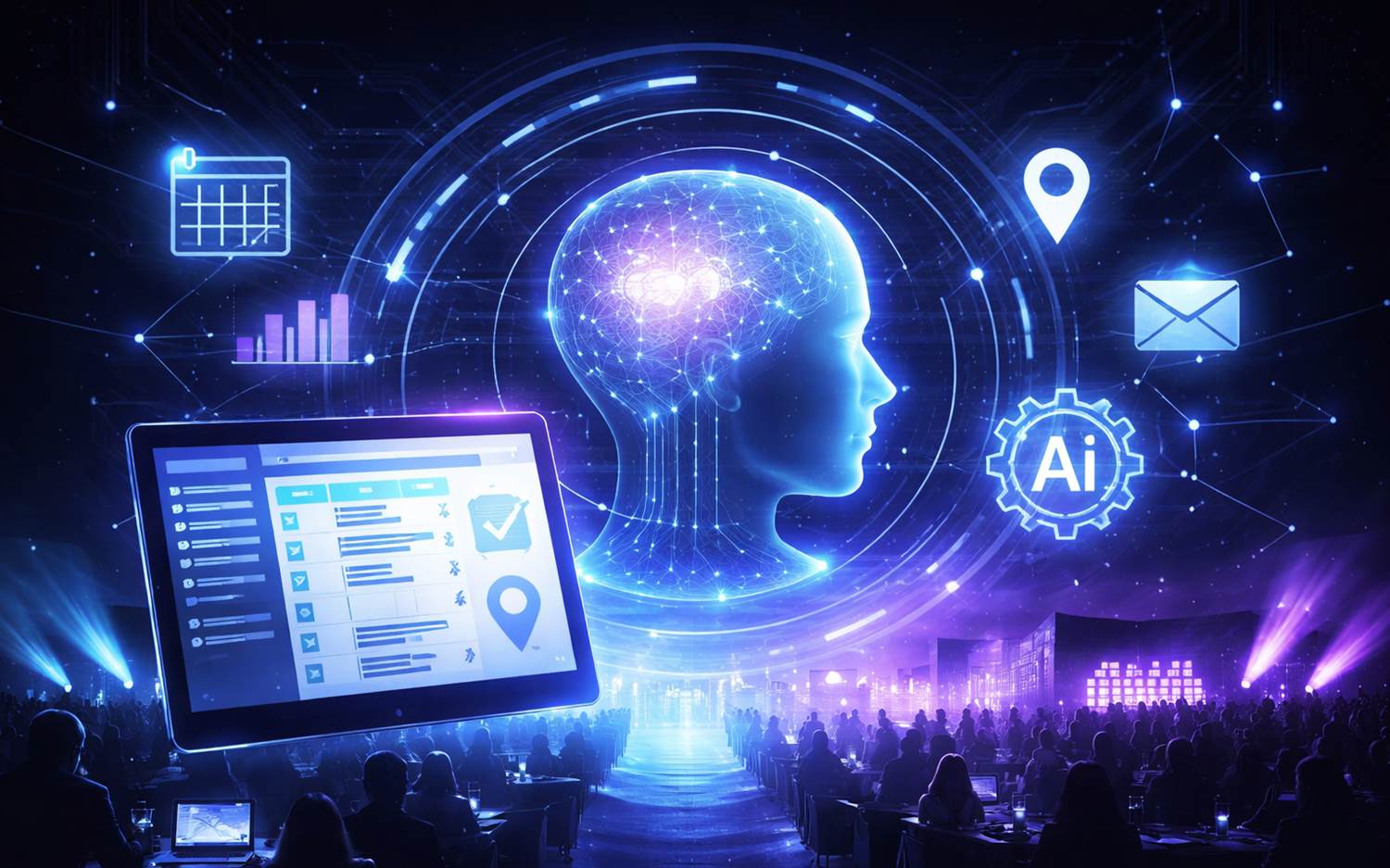
Cover image: AI in Event Management – key visual created with AI by the EventMasterBook editorial team
Related topics: AI in event management, ChatGPT event chatbot, attendee communication automation, AI-powered event app, ChatGPT apps for events, event chatbot use cases, digital event assistant, AI attendee support, event technology trends, Retrieval Augmented Generation RAG, event app ChatGPT integration, AI for conferences and trade shows, automated event communication, event management software AI
Summary: AI in event management – ChatGPT apps automate attendee communication, reduce workload, and improve service quality. Learn use cases and how to build a chatbot.
Please note: This text was translated from the German EventMasterBook.de Event Magazine (see article: KI im Eventmanagement – Teilnehmer-Kommunikation automatisieren mit ChatGPT). Please excuse any translation errors.


