

The inaugural Made in Germany Awards provide Germany’s innovation ecosystem with a new platform. The event concept combines science communication, creator entertainment, community participation, political representation and innovation funding. Its focus extends beyond recognising innovative solutions to the economic and societal challenges of our time: it seeks to communicate a positive vision for Germany’s future.
On 23 November 2026, the Made in Germany Awards were presented for the first time at Berlin’s Futurium. Under the patronage of Dorothee Bär, Federal Minister for Research, Technology and Space, science YouTuber Dr Jacob Beautemps, together with the Federal Ministry for Research, Technology and Space (BMFTR) and the Federal Agency for Breakthrough Innovation (SPRIND), honoured some of Germany’s most innovative future-shapers.
The awards ceremony was livestreamed on YouTube and Twitch via the Breaking Lab channel. The hybrid event format thus combines the traditional awards ceremony with the communication dynamics of the digital creator economy.
The Community as a Science Jury
Innovators submitted several hundred projects across five categories: Energy, Mobility, Medicine, Artificial Intelligence and Society. An expert jury comprising representatives from SPRIND and BMFTR selected three finalists in each category, whose projects were presented in detail on the Breaking Lab YouTube channel ahead of the event.
Based on these presentations, the community selected the winners through a public vote. The organisers describe the participating community as Germany’s largest science jury.
The Winners of the Made in Germany Awards 2026
Energy: Industrial Production of Lithium Metal Anodes
The Energy category was won by Skellium GmbH, represented by co-founder Gerrit Bockey, for its innovative liquid coating process for battery anodes. According to the organisers, the new process enables the industrial production of ultra-thin lithium metal anodes for the first time. Their higher energy density could significantly extend the range of electric vehicles.
Mobility: More Efficient Electric Motors
The Mobility award also went to an innovation in the field of electric mobility. The winner was DeepDrive, represented by Dr Alexander Rosen, the company’s co-founder and Chief Engineer. DeepDrive’s Dual Rotor technology introduces a new electric motor design that uses two rotors instead of one. The concept is intended to increase vehicle range and efficiency while reducing costs.
Medicine: New Approaches to Preserving Memory Function
The winner in the Medicine category was CogniSia, represented by project leader Dr Hauke Thiesler from the Institute of Clinical Biochemistry at Hannover Medical School. The project is being developed in collaboration with Hannover Medical School and the German Center for Neurodegenerative Diseases in Magdeburg. CogniSia is designed as a nasal spray that uses a naturally occurring polysaccharide in the human body to help preserve memory function and potentially protect against dementia in the longer term.
Artificial Intelligence (AI): Digital Navigation Assistance for Blind People
In the Artificial Intelligence category, the award went to VisiNav, an app developed by 19-year-old Timo Henkel. Using AI, the application translates the surrounding physical environment into intuitive 3D audio signals designed to help blind people navigate their everyday lives safely. The system requires no specialist hardware and operates entirely offline on the user’s smartphone.
Society: Preserving Expert Knowledge for Future Generations
In the Society category, Dr Anjela Mayer received the Made in Germany Award. The computer scientist and XR researcher is the driving force behind SKI²LL-AI, a mixed-reality training platform. The application aims to preserve practical expert knowledge for future generations by automatically recording work processes through a mixed-reality headset and subsequently reproducing them as three-dimensional instructions.
Honorary Awards Showcase Innovation Across Generations
Alongside the awards in the five competition categories, several honorary awards were presented during the ceremony.
Dorothee Bär, the event’s patron, presented the Federal Minister for Research, Technology and Space’s Pioneering Spirit Award to ESA astronauts Dr Alexander Gerst and Dr Matthias Maurer, two of the best-known figures in Germany’s space sector.
The Generations Award went to 95-year-old Gerhart Wissel for developing the E-hiker, an electrically powered hiking aid combining elements of a mountain bike and a wheeled walking frame. Wissel founded the start-up Wissel Alpin to manufacture and market his invention.
The Generations Award was also presented to 18-year-old inventor Eva Shi, who has already developed multiple inventions. Her current research focuses on the magnetic control of extremely small objects. In the future, tiny robots guided through the human body by magnetic forces could enable less invasive and more precise medical procedures. Shi has successfully demonstrated how a small magnet can be levitated without physical contact and controlled with millimetre precision.
The Lifetime Achievement Award concluded the ceremony and came as a surprise to its recipient: Prof. Dr-Ing. Karlheinz Brandenburg, known as the "father of MP3" and the "sound engineer of the digital revolution". Brandenburg laid important foundations for MP3 technology during his doctoral research. Working with a research team at the Fraunhofer Institute for Integrated Circuits (IIS), he subsequently achieved a breakthrough in a technology that fundamentally transformed the way people around the world listen to music.
Confidence in the Future as a Guiding Communication Principle
Beyond recognising individual achievements in research and development, the new awards format positions itself as a platform for communicating a positive vision of society’s future.
Dorothee Bär, Federal Minister for Research, Technology and Space and patron of the Made in Germany Awards, commented:
"The Made in Germany Awards demonstrate what our country stands for: outstanding ideas, technological excellence and the courage to break new ground. I warmly congratulate the winners. They represent a new generation of researchers and entrepreneurs who are moving our country forward. The innovative strength of all the teams gives us reason to look forward to the future and encourages us to pursue new ideas with determination."
Dr Jacob Beautemps, science YouTuber behind Breaking Lab and host of the Made in Germany Awards, added:
"When you watch the news today, it is easy to get the impression that everything is going downhill. Tonight has shown the opposite: our award winners demonstrate that our world has never been as full of solutions as it is today. People often say that hope is not a strategy. I see things differently. Confidence in the future is a prerequisite for any strategy: without it, no laboratory conducts research, no company invests and not a single innovation comes into being. That is precisely the confidence our winners brought to the stage tonight."
Rafael Laguna de la Vera, Director of the Federal Agency for Breakthrough Innovation (SPRIND), said:
"Breakthrough innovations emerge wherever people are prepared to make the seemingly impossible possible. That is exactly what we aim to foster at SPRIND: we bring together visionary projects, outstanding talent and entrepreneurial courage to turn technological possibilities into tangible solutions with societal impact. The show vividly demonstrated the wealth of innovative potential that exists in Germany. Our task is to give that potential the financial freedom, the right partners and, ultimately, a genuine opportunity to become reality. We must not be content to experience our future merely as spectators – we must actively shape it ourselves."
Beyond Recognition: Turning Awards into Innovation Funding
One of the distinctive features of the event concept is its combination of public recognition and tangible funding opportunities. All submitted projects were assessed by experts from the Federal Agency for Breakthrough Innovation (SPRIND) and evaluated for potential funding.
During the awards ceremony, SPRIND announced that the teams behind CogniSia (Medicine), Iris (Artificial Intelligence) and Synplasma (Energy) would receive funding offers. Each of the three teams will be awarded a validation contract worth approximately €200,000, representing a total funding volume of around €600,000 to validate the three projects.
Should SPRIND’s experts remain convinced of the projects’ breakthrough innovation potential following the completion of these contracts, further funding may be provided in the form of a start-up grant, a research contract, a convertible loan or an equity investment.
The awards ceremony thus serves not only as a vehicle for public recognition but also as a platform for concrete decisions on the further development of technological innovations.
Futurium: The House of Futures as a Venue with Symbolic Significance
By selecting Berlin’s Futurium, the House of Futures, the organisers chose a venue whose institutional mission directly reflects the central message of the event.
Science creator Dr Jacob Beautemps was the creative driving force behind the concept and hosted the ceremony. The livestream on YouTube and Twitch via his Breaking Lab channel extended the physical event space to encompass a digital audience.
LEONINE C_, the LEONINE Studios content studio specialising in branded and creator entertainment, was responsible for the conceptual development, organisation and production of the awards show.
EventMasterBook Editorial Commentary: Confidence as the Event’s Central Theme – Participation as an Experiential Principle
The Made in Germany Awards address one of the defining issues of our time: while technological progress continues to open up new possibilities, many people look to the future with growing concern. The awards show deliberately counters a public perception shaped by crises with a positive vision of the future. Rather than simply calling for greater optimism, the event makes confidence tangible through specific innovations and the people behind them.
Equally interesting is the new meaning being attached to the term "Made in Germany". Traditionally associated with quality and German engineering excellence, it is now being positioned to represent the ability to develop solutions to tomorrow’s challenges. The event therefore also serves to strengthen Germany’s image as a centre of innovation.
The communication approach itself reflects the zeitgeist. Public institutions draw on the reach and communication skills of a science creator to make scientific topics accessible to a wider audience. By presenting the projects on YouTube and inviting the community to vote, the organisers actively engage audiences well before the live event takes place. The awards ceremony becomes the culmination of this participatory process. Honouring inventors from different generations also reinforces the message that the spirit of innovation knows no age limits.
What truly distinguishes this event concept, however, is that it goes beyond the public recognition of innovative achievements. SPRIND’s funding offers create tangible opportunities for the further development of selected projects.
For the event industry, this approach is particularly noteworthy. It illustrates how live communication can evolve into a means of actively shaping the future. The future is not merely presented on stage – concrete steps are being taken to turn that vision into reality.
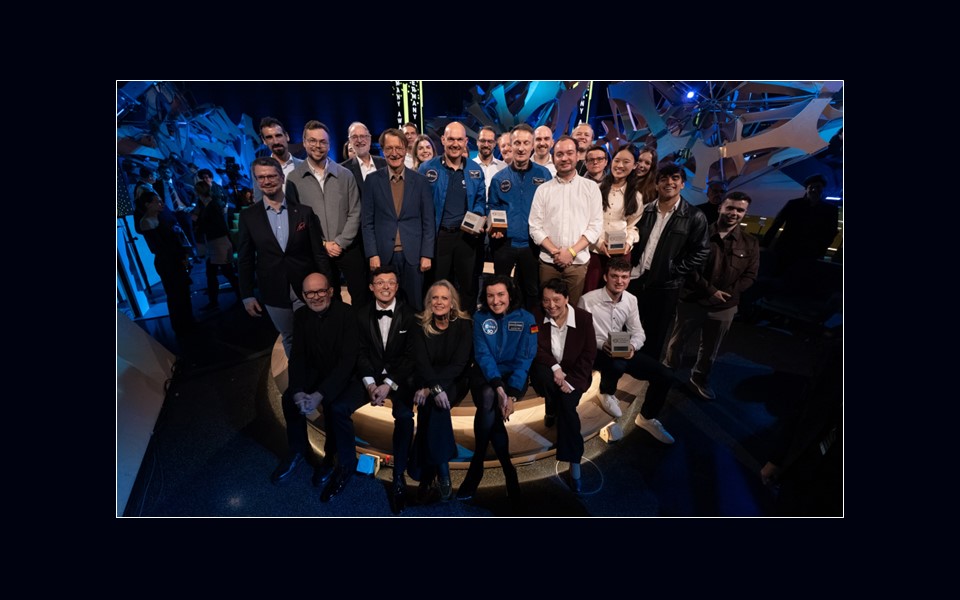
Cover image: Made in Germany Awards 2026 – Winners and award presenters (Photo credit: i&u Studios / Jonas Peschel)
Related Topics:
Made in Germany Awards 2026, Made in Germany, Futurium Berlin, Jacob Beautemps, Breaking Lab, Dorothee Bär, SPRIND, German Innovation Awards, Awards Ceremony, Event Concept, Live Communication, Event Marketing, Experiential Marketing, Science Communication, Science Creator, Creator Economy, Creator Entertainment, Community Engagement, Audience Participation, Public Voting, Hybrid Events, Digital Event Formats, Future-oriented Communication, Confidence in the Future, Societal Zeitgeist, Nation Branding, Impact-driven Live Communication, Innovation Funding, Event Dramaturgy, Event Strategy, LEONINE C_, Alexander Gerst, Matthias Maurer, Karlheinz Brandenburg, Skellium, DeepDrive, CogniSia, VisiNav, SKI²LL-AI, EventMasterBook Magazine
Summary:
The inaugural Made in Germany Awards, held at Berlin’s Futurium on 23 November 2026, combine a traditional awards ceremony with science communication, creator entertainment, digital community participation and tangible innovation funding. The event concept counters a public perception shaped by crises with a solution-oriented vision of the future. From a live communication perspective, the combination of institutional authority, digital participation, emotional storytelling and tangible impact is particularly noteworthy.
Originally published on EventMasterBook.de | Translated and edited for EventMasterBook.com. Please excuse any translation errors. Read the original article (German): Made in Germany Awards 2026


