Soccer is officially leaving its niche behind in the United States, rapidly evolving into a mainstream phenomenon. In the run-up to the 2026 FIFA World Cup™, this shift opens up unprecedented opportunities for brands, sponsors, and event professionals. The latest Nielsen report, "Get Ready with Media Intelligence: 2026 FIFA World Cup Edition," provides a detailed look at exploding reach, radically altered second-screen habits, and a whole new level of fan engagement.
To understand the dynamics of major soccer (respectively football*) events, industry experts can no longer look solely at traditional core markets in Europe or South America. The US market is currently undergoing a profound transformation. Nielsen’s recent data report meticulously analyzes the four central pillars of this evolution: marketing potential, viewership trends, interaction behavior, and the tangible impact of the 2026 FIFA World Cup™ on the local market.
Viewership Trends: The US Market in Transition
The sheer numbers in the Nielsen report highlight the massive relevance of soccer across the Atlantic: in 2025 alone, viewers in the United States consumed a staggering 79.8 billion minutes of soccer broadcasts. Furthermore, there is no sign of market saturation. On the contrary, a third of the total US population (33 percent) firmly expects their personal interest in soccer to increase over the next 18 months.
When looking closer at the existing soccer (respectively football*) community, this trend intensifies significantly: 64 percent of US soccer fans expect their own interest in the sport to grow. The upcoming tournament – hosted across the US, Canada, and Mexico – acts as a powerful emotional catalyst, with 56 percent of current fans stating that the 2026 World Cup™ will noticeably boost their enthusiasm for the sport.
Internationalization of the US Audience
Another key finding of the media analysis is that the US audience is increasingly thinking globally and embracing international soccer competitions. A prime example is the average viewership for the 2024 Copa América™, which more than doubled compared to the 2021 tournament. European and continental tournaments are also highly popular: both the UEFA Women’s Euro™ and the CONCACAF Gold Cup™ recorded massive ratings growth in 2025.
Particularly insightful for strategic campaign planning is the ranking of the three most-watched soccer leagues in the US market in 2025:
- Liga MX™: The Mexican top tier leads the field, underscoring the immense importance of the Hispanic target demographic.
- UEFA Champions League™: Europe’s elite club competition captivates the US audience with world-class football.
- Premier League™: The English top flight secures third place in viewership rankings, thanks to excellent marketing and a shared language.
Torsten Vennemann, Market Lead DACH + Eastern Europe at Nielsen Sports, explains:
"For brands in Germany and Europe, soccer has long been deeply embedded in everyday culture, media consumption, and fan identity. This makes the current development in the US all the more exciting: soccer there is undergoing a similar transformation phase and is increasingly becoming a true mainstream sport. Looking ahead to the 2026 FIFA World Cup, brands have a unique opportunity to build authentic, long-term connections with fans at a defining moment for the sport. European markets can provide valuable insights on how to successfully create sustainable fan engagement and long-term brand relevance around sports."
Engagement Trends: Digital Hyperactivity and Second-Screen Culture
For event managers and marketing professionals, the report’s greatest value lies in its breakdown of media and interaction behavior. American soccer fans no longer consume sports passively – they are highly interactive networkers.
- Above-Average Social Media Usage: An impressive 79.5 percent of soccer fans actively use social media to consume sports news and additional content, compared to just 61.9 percent of the general population. Partnerships with specialized soccer channels, high-reach sports media, or content creators offer brands highly native touchpoints.
- Millennials as Second-Screen Pioneers: Contrary to popular belief, it is not Gen Z that utilizes the second screen most intensely during live sports events, but Millennials. A remarkable 86 percent of Millennials use a smartphone or tablet parallel to a game, closely followed by Gen Z at 83.2 percent. Both groups significantly exceed the already high average for all soccer fans (79.4 percent).
- Multitasking as a Marketing Opportunity: Alongside classic social media interaction, top second-screen activities include digital gaming, mobile food delivery, and tracking real-time sports news. This opens up complementary commercial opportunities to reach fans at the exact moment of peak emotional engagement.
- Audio and Podcast Boom: An often-underestimated channel is proving highly effective: 77 percent of American soccer fans specifically use radio and podcasts to stay informed about current sports events and consume deeper analyses.
In summary, anyone planning to use the 2026 World Cup™ as an advertising or experiential platform cannot rely solely on traditional TV presence. Engagement happens across a multitude of parallel channels.
"To understand where fans are watching and how they are engaging with the world’s most popular sport, Nielsen is sharing its new, exclusive insights and capabilities surrounding the World Cup," concludes Seth Ladetsky, Head of Global Sports at Nielsen. Only those who effectively orchestrate these various channels will achieve lasting success at this historic moment in sports history.
The full Nielsen report, "Get Ready with Media Intelligence: 2026 FIFA World Cup Edition," is available at: https://www.nielsen.com/fifa-world-cup-media-intelligence/
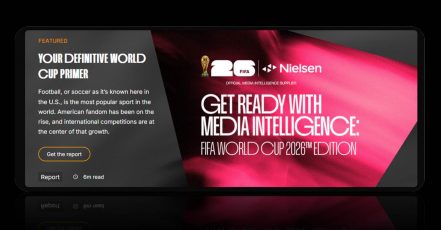
Cover image: Screenshot from June 2, 2026, of the Nielsen Report website (Source: nielsen.com, link above)
*Good to know: Soccer vs. Football
As the world gears up for 2026, the tournament also brings a classic linguistic debate back into the spotlight: Soccer versus Football. While the governing body FIFA uses "football" globally, the host nations present a divided front. In the United States and Canada, the term "soccer" reigns supreme to distinguish the sport from American football and Canadian football. Meanwhile, Mexico, the third host nation, strictly refers to it as "fútbol." Globally, the terminology follows distinct regional lines. The term "soccer" – which, interestingly, originated in 19th-century Britain as an abbreviation for "Association Football" – is primarily used in countries where other football codes dominate, including Australia, New Zealand, South Africa, and Ireland. Conversely, across Europe, South America, Africa, and most of Asia, the game is universally known as "football" (or its local translations). For international brands, navigating this linguistic divide during the World Cup is key to delivering culturally authentic marketing campaigns.
Editorial Note (with a cross-reference on our own behalf):
The global football (soccer) hype is, of course, a massive opportunity for the event business. Any company or club looking to create their own event for the 2026 major football tournament can benefit from the 54-page Football Watch Party Planner by EventMaster.Club.Packed with numerous ideas and tips – from venue selection to follow-up – this free e-book is available to the EventMaster.Club community. (This publication is not affiliated with FIFA or the 2026 FIFA World Cup). Click here for the download page: https://eventmaster.club/en/r/football-watch-party-planner-2026
Related Topics:
2026 FIFA World Cup, World Cup 2026, Nielsen Report, Event Management, Sports Marketing, EventMasterBook, US Sports Market, Fan Culture, Public Viewing, Second Screen, Social Media Trends, Millennials, Gen Z, Sponsoring, Media Analysis, Live Marketing, Event Planning, Football Watch Party Planner, Public Viewing Event, EventMaster.Club, Viewership Trends
Summary (Abstract):
The latest Nielsen report on the 2026 FIFA World Cup™ confirms a historic structural shift: soccer is rapidly transforming into a mainstream sport in the US. With an astronomical 79.8 billion minutes streamed in 2025 and a highly active second-screen culture among Millennials and Gen Z, the mega-tournament unlocks entirely new potential for brands and event planners. The report analyzes viewership trends and digital engagement channels, demonstrating how marketing, events, and sponsorship must be cross-medially orchestrated in 2026.
Originally published on EventMasterBook.de | Translated and edited for EventMasterBook.com. (Please excuse any translation errors.) Read the original article (German): Nielsen Report belegt US-Fußball-Boom
Tip: Join our community on Instagram for the latest magazine sneak peeks: @eventmaster.club